Posted by
Marde Ross on Sun, Feb 19, 2012 @ 05:35 AM
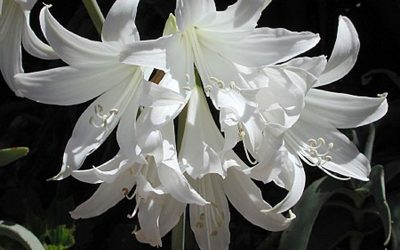
Originally from Africa, Gloriosa lilies are beautiful, easy to grow, and will multiply.
Glowing crimson red with a yellow base and slight yellow edge, they are a splendid low climber, easy to grow. Grows 5-6 feet high, producing many lily-like flowers of exceptional beauty over an extended period, are suitable for potting and are long lasting cut flowers. If the flower vines are not cut, the tubers will double and they are perfectly adapted to our area. They will take full sun, good drainage. Water well while growing and provide something to climb on like walls, fences, trellises.

Lay long tubers flat and cover with soil.
The tubers can be planted in a trench along a fence or wall about 6" apart and about 3-4" deep in good soil with drainage. Water thoroughly. When growth begins in the spring. they should be given a liquid fertilizer once a week to encourage new growth. Later on in the season a half strength fertilizer added to the water every two weeks will keep plants blooming strongly throughout the summer and sometimes further into early autumn.
Posted by
Marde Ross on Fri, Feb 10, 2012 @ 02:00 PM
This photograph of Ice Follies shows the size of the bubs. These each have 4 bulbs attached at the base and are sometimes called Mother Bulbs! These will produce at least 4 daffodil flowers and cannot be found in nurseries as they are expensive to ship. Nurseries typically buy "double nose" #2 which have two bulbs but are of second size.
I placed these bulbs on an 11" platter to show the scale. These bulbs have 4 bulbs attached as one (they are sometimes called Mother Bulbs) and some others have 3 and some have 2. I weighted out a shipment of 50 of them to mail and found that 50 weighted 12 pounds!
Varieties differ by size and formation, but they are always the largest available to give long life and duribility to whatever you are planting,

5 Clusters of Ice Dollies Daffodils containing 17 bulbs on an 11" platter.
Posted by
Marde Ross on Thu, Jan 19, 2012 @ 04:51 PM

Organic material

Heavy Clay Soil
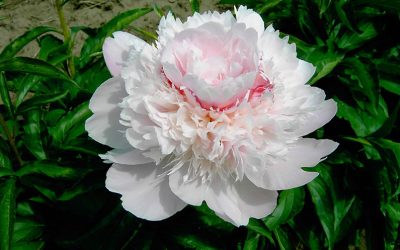
Preparing the soil for planting bulbs is important. For peonies and tulips the soil pH should be 6.0 to 7.0 or neutral. Heavy clay soils are not desirable, so poor soils should be amended with organic matter like compost, peat moss or your own compost pile before planting. Loamy soil is ideal. Both peonies and tulips will do well in full sun or partial shade, but in California and warm weather climates, peonies need filtered sun or part shade during the hottest part of the day. In full sun, some extra water on hot spring days will extend flower life and allow the bulbs to mature properly after flowering.
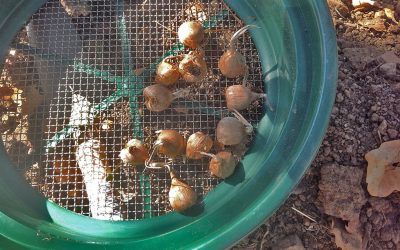
When I lived in Palo Alto, California where I had heavy clay soil, I used a three foot square half inch screen build with a wooden frame set on saw horses to separate my soil from hard lumps and rocks and added a large pile of aged redwood debris that had accumulated under the largest redwood in the city. It made a wonderul, fluffy soil which maintained the water holding quality of the clay with the added benefit of organic matter providing spaces for oxygen, nutrients and water.
Posted by
Marde Ross on Thu, Jan 19, 2012 @ 04:26 PM
My listing of tulips available on my price list, are tulips that I have grown for many years and are my favorites. I have grown many which are not on that list, but these are among the most beautiful and reliable of those available that I can still obtain.
There have been few new tulips available commercially over the twenty six years that I have been in business. Many older ones which were wonderful, are no longer available. One of my very favorite tulips was expensive, had a yellow satin lining with a pale yellow cream outside was replaced with a poor substitute under the same name (and of course, same price!). Sometimes, bulb suppliers will substitute a similar "color" for one that was ordered. I have learned to avoid those suppliers.
Tulips are ordered and delivered in the fall of the year. In cold areas, they can be planted immediately and they do not need pre-chilling and it is much easier to plant them when the weather is pleasant and the ground not frozen. Pre-chilling makes them stronger and of equal height and I refrigerate all of my tulips until my customer is ready to plant them. Check and discard any bulbs with rot on the basal plate which will affect the growth of the bulb. Blue mold, nicks and missing skins do not affect the viability of the bulb as long as the basal plate in not damaged or rotting.
Dig down about nine inches, and if they are to be left in the ground, dig in a handful of bulb meal or bone meal into the soil below where the bulbs will sit being careful not to let the meal touch the bottom of the tulip bulbs, as it could burn the roots of the bulb. Add about one inch of soil and then arrange the bulbs so that they are about 4" apart with the points facing upward. Replace the soil and water them in if no rain is forecast.
In warm weather climates, chill the tulip bulbs for about 8 weeks before planting them in the same way as mentioned above. As tulips will not rebloom reliably, the addition of bone meal or bulb food is not necessary.
In the photo above, daffodils and muscari are mixed into the border planting along with the tulips. They will return in the cold climates, but will not in warm climates.
Why won't tulips rebloom in warmer climates?
There is an interesting answer to this question. In Holland where many of the tulips bulbs are grown, they are artifically made larger by mowing the tulip fields to cut off their heads just as they are about to bloom. This forces the bulb to grow larger. "French Tulips" are forced for a second year, and as a result for either group, the bulbs cannot wait to divide when they finally are allowed to bloom! Thus, the result is many small bulbs, most of which are too small to bloom and just send up green shoots. These are replanted in Holland or in cold climates to grow on. In warm climates, only about 20% of tulips will rebloom, but they are smaller blooms with varying heights, and certainly not the showy groupings of the first year.
I treat tulips as annuals, thank them for their efforts and pull them out after blooming to make room for annuals or to leave the bed neater.
Posted by
Marde Ross on Wed, Jan 18, 2012 @ 06:06 PM
Oh, the beauty of massed tulip and daffodil bulbs cannot be beat!
Posted by
Marde Ross on Wed, Jan 18, 2012 @ 04:38 PM
The usual rule of thumb is to plant bulbs three times the distance from base to shoulder of the bulb. There are exceptions which I will go into at the end of this post.

These large #1 size daffodil bulbs are the largest available and not found in nurseries. The planting dept of these triple bulbs is measured from the base to where the bulb begins to narrow, or the shoulder. If that measurement is 3", then the bulb is planted with 6" of soil above the bulb.


These charts indicate that the general planting depth for tulips is 8", daffodils is 6+ inches, spring blooming crocus is 2", and anemones go down 1-1/2". The fall blooming Crocus Sativus is planted 4" deep.
In my case, I plant tulips shallowly and treat them like annuals so that they are easy to pull out and throw away after they bloom, as they need very cold weather to naturalize.
The Giant Scilla is an exception as it stands with about a third of the bulb above soil level!
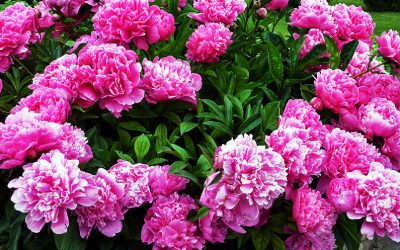
Peonies are planted very shallowly with the pink or white buds 1/2 inch below ground level.
Of course, the soil should be well amended and loosened before planting if possible.
Posted by
Marde Ross on Wed, Jan 18, 2012 @ 03:36 PM
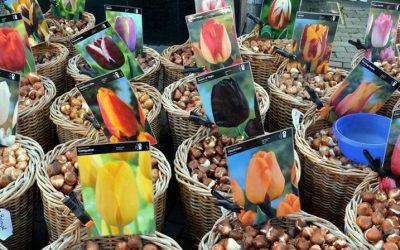
Bulbs can be ordered at any time during the year, but the delivery is usually from September through January for spring flowering blooms. Spring crocus (which needs pre-chilling) and fall blooming, Crocus Sativus (which does not require chilling) are available.

Crocus Sativus pictured above is a fall blooming, warm climate corm which blooms 2" high and is a nice filler around other plants and naturalizes. The red stigmas can be pinched off during the blooming period for use in cooking.
Daffodils arrive in the fall and can be planted all thoough the months just short of the spring blooming time. Some narcissus (special hybrids) will start blooming in September and some others every month through April.

Early blooming varieties like February Gold, Trevithian, and Golden Dawn are followed by Ice Follies, Scarlet O'Hara, Dutch Master and latest varieties which are Unsurpassable, Salome, Cheerfulness, Yellow Cheerfulness and Thalia.
Peonies can be ordered at anytime and are usually delivered in the fall, but can be planted into January or later if need be. They can be dug up and moved anytime except while they are blooming.
Tulips are best ordered early so that there is time to refrigerate them for 8 weeks or so. I refrigerate all of my tulips until they are sold or until November/December when customers are ready to plant locally.
Bulbs are really pretty foolproof!
Posted by
Marde Ross on Wed, Jan 18, 2012 @ 12:58 PM
What are bulbs and corms?
Everyone is familiar with the basic and most popular bulbs like tulips and daffodils which are true bulbs, but corms are important and popular as well. Anemones, ranunculous, gladiolus and crocus are corms. A corm is defined as an swollen, underground stem that contains food stored for the plant.
The corm on the left is a ranunculous and it is planted with the points down, as the stems and blooms emerge from the top. On the right is crocus sativa showing roots beginning to emerge. The pointed top of this corm is planted up and it looks very much like a bulb.

Anemones are strange looking corms and vary between the single and double varieties. The slightly rough looking spot is planted up.
Iris and peonies are roots. They die back and the food is held in the roots for further bloom.
Posted by
Marde Ross on Wed, Jan 18, 2012 @ 12:29 PM
Bulbs are dormant when they have died back to nothing more than the brown, dried, fat root. That root has all of the nutrition that it will need for the next year's successful bloom. It is important to keep bulbs cool and in dark, dry conditions until they are planted, whether they have been dug out of the ground after dying back or are fresh and new from the grower or supplier.

Some bulbs need to be chilled before planting in warm weather climates, like most of California and in the southern states. Tulips need chilling for about 6-8 weeks or longer if that is most convenient. I have planted tulips bulbs that have been left over and with almost 14 weeks of refrigeration and they have bloomed nicely. On one occasion, I planted some Darwin Hybrid tulips on April 1 after 22 weeks of chlling and they bloomed 2 weeks later with no roots!
Freesia, hyacinth, saffron crocus, and lilies need refrigeration if they are not planted after receiving them to keep them from beginning to keep the roots from beginning to grow. Daffodils do not need chilling but they do need to be kept in dark, dry storage as in a garage until time to plant. Other bulbs like giant scilla, lycoris, ranunculous, anamones and other warm weather bulbs and corms just need cool, dry, dark conditions.
Posted by
Marde Ross on Sun, Dec 18, 2011 @ 02:14 AM
Although most of the plantings on my property are not tasty to the gopher, I still have a big population. I think the family of owls that I discovered this summer has helped to reduce their numbers, just yesterday, I noticed a grouping of new holes with the soil pushed out around the openings to their tunnels. Daffodils and peonies are not bothered by these rodents as they are toxic in flavor to them, so I thought of putting a daffodil down in the hole as a kind of insult. They may decide to "unplant" them by pushing them out and away, but the sight of a freshly dug hole just the size for a fat daffodil is very tempting.

This photo taken at dusk shows one of my two baby owls on top of the owl box which stayed empty for several years before attracting the pair of barn owl that produced the young. Whenever I saw them, they never took their eyes off of me, and through a night vision monocular their eyes looked like shiney marbles.

I had an opportunity to catch both babies on the rooftop, but just as I was zooming in, Cedric, my Springer Spaniel rushed at them barking and they flew off. That was the last time I saw them together as one was usually in the tree next to the box.